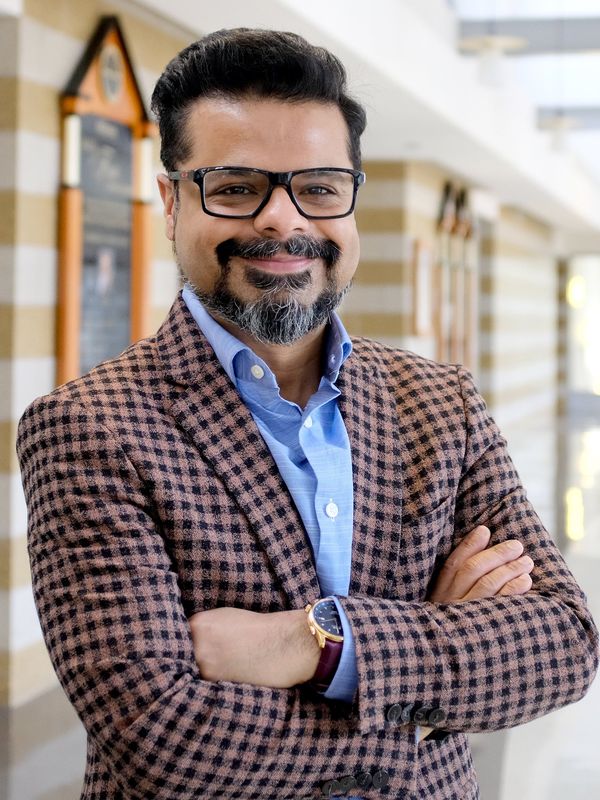
Thank you for reading this Author Interview with Professor Avi Datta, author of The Time Corrector Series, which includes The Winding, The Movement and The Reset (newly launched on Feb 1st, 2024).
The third and final book, The Reset, was launched on February 1st, 2024. The first two books in the series have a 4.5 stars rating on 215 ratings and a 4.8 stars rating on 205 ratings.

Below is an Author Interview with Professor Avi Datta, author of The Time Corrector Series, on launch of the third and final book of his series
You can also read our earlier Author Interview with Professor Avi Datta here.
Q1 Professor Datta, now that your Trilogy (Time Corrector Series) is complete, how would you introduce it to new readers? What do you think readers would get out of reading your Trilogy?
That’s a great question. I would like the readers to steer away from two core myths.
- There are clear good and evil forces. Since most of the book is created from Vincent’s POV, one would assume that he is a force of good. Around the end of my second book (The Movement), we see that the supposed antagonist’s life was fractured because of Vincent. But as we move on to the Reset, we will see the overall identity of one “Lunatic” and how good and evil may be the mirror reflection of each other.
- Time is linear. We measure time by the passage of it, which is the Earth’s rotation around its axis and revolution around the sun. I don’t think Universe does not care. Instead of explaining this with quantum mechanics, I decided to show that through someone who experiences this ability, which becomes a gift and a curse.
Some readers have often complained about too much opulence in my book. To balance that, the struggles are also exceptionally high stakes.
Q2 Writing a book series is a huge endeavor. Now that you have finished an entire trilogy and received awards and many good reviews, how does it feel? What advice would you have for fellow authors and prospective authors who want to write a book and/or a series?
For me, the best feeling is the act of writing and plotting. I have an enigmatic relationship with one of the characters in the book, and my writing helps me to connect with them. No amount of reviews or awards can match that.
I don’t think I can advise anyone, let alone writers. All I can say is that I wrote something that resonates with me. I did not write for the market (given my queries were never answered), so I had to self-publish. But, I must warn other authors who are self-publishing. It’s a lot of work despite the control you get. And if one is introverted and neuro-diverse, it becomes even more challenging.
Q3 With the Trilogy complete, do you feel you personally got what you wanted out of writing this Trilogy? You mentioned last year that you debated extending the Time Corrector universe beyond this Trilogy. Have you made a decision? Do you feel there would be a prequel or a sequel in the future?
I did. And yes, I am plotting an extension of the Trilogy in a manner that can also bring in new readers. It will be a sequel because the realities of Post-Reset and Pre-Reset are running in parallel. But I have decided not to give myself a stringent deadline.
Q4 If/When Time Travel is discovered/invented, how would it change humanity?
Assuming it gets invented (which it won’t), humanity will use it to not learn from mistakes. So yes, it will change humanity, but not necessarily for its betterment.
Q5 In your first Author Interview with us, you said,’ An ideal reader would not perceive emotion and logic as mutually exclusive entities but as equally important in making decisions.’ How can a reader (or a nonreader) cultivate this ability to factor in emotion and logic in making decisions?
Yes. It can be done. And it is very individualistic. For me, listening to classical music works. While the rhythms associated with the notes are mathematical, the feelings invoked can help craft scenes for a book or even compose a whole painting. The left and right brains can work in sync when someone deeply enjoys their work.
Q6 A literary critic recently said that Literary Fiction is where nothing happens and is written about beautifully. Genre Fiction is where a lot happens, and it is written about boringly. We feel that with your books, you are one of a select group of authors writing very well-written books with a lot of ‘forward’ motion and progress. What can authors do to get both ‘good writing’ and ‘good plot progress’ in their books?
Hasn’t the critic read “Great Expectations,” “A Tale of Two Cities,” or “LOTR?”
Writing well is a craft, and plotting is the brainchild of imagination. I believe they are both essential to keep the reader engaged. It’s like a painting. Dali’s paintings are the most imaginative, and his skills are often off the chart. Very few artists have mastered this. I am sufficiently bored with my reality to construe a far more dramatic one.
Regarding the skill, I don’t use many complicated vocabularies. But I write exactly the way I feel, whether I am listening to Liszt’s Consolation no. 3 or when I touch fallen blooms of Sakura or stare at the sky. I keep writing until there is no process loss in what I thought and felt. However, I am not very good at verbally expressing what I feel.
Q7: Would you consider writing a companion non-fiction book for the Trilogy that covers, explains, and expands on all the concepts introduced and covered in your Trilogy?
As a professor, I write research papers. Most of them serve as the perfect sleeping pill for insomniacs. When I embarked on this journey, I wanted to write something that creates insomniacs instead of curing them. Non-fiction may fall into the trap. So if someone else writes it, I may help.
Q8 Professor Datta, given your unique background of being a Professor of Strategy and Entrepreneurship at Illinois State University, what books on Strategy would you recommend? Do you think the focus on a select few authors and books (Machiavelli, Sun Tzu, Miyamoto Musashi) is justified or are there a lot of hidden gems on Strategy that most readers are unaware of?
Igor Ansoff’s Business Strategy (has excellent selected readings). If you are looking at a holistic approach to Strategy, nothing beats Peter Drucker’s work. Igor’s background was in applied mathematics.
Q9 You mentioned in your earlier interview with us that you extensively studied great technologies that fail and terrible ones that succeed. You also talked about how transferring consciousness between humans and machines would be one such invention. We have had an immense amount of AI developments in 2023. How close do you think we are to being able to transfer consciousness between humans and machines? Which company or country do you think is best placed to achieve this?
The key to consciousness transfer may be the ability to build microprocessors the size of human cells. Yes, microprocessors are getting smaller, but in their current state, they will reach saturation limits before attaining that size. I make it earlier in my book via Intreton. So I say, another fifty years. Most likely, it will be a start-up from the Valley that will be absorbed by Microsoft or Google. This technology cannot progress unless some general standards are created. The demarcation of Medicine, Nano-tech, Computer Science, and Biotech will be negligible then.
Q10 You talked about the inspiration for The Time Collector series being your dream in 1994, where you spoke fluently with a girl in Japanese and trains were flying over buildings. The dream reappeared in 2020, and you wrote the story so you would not forget it. Have you had any such dreams recently? Are these going to be the inspiration for your new books? Have you had any more dreams about Akane?
Akane conquers my dream every day. I talk to her in Japanese daily, which confuses my dog, Bruce The Magnificent. He stares at me, wondering, “Who he is talking to?”
Q11 There is a rich precedent of authors being inspired by their dreams (Kubla Khan: or A Vision in a Dream by Samuel Taylor Coleridge comes to mind). Do you think this is the subconscious creating stories, or something from a different reality, or something from a past life?
The real question is if the past life happened in the past or is happening now. When I visited Kiyo Mizu Dera in Kyoto, I knew some of the shrine’s locations. When my Host professor asked, “Did you virtually visit this place?” I could only say, “I came here with Akane in my dreams, so I know the place.” Kiyo Mizu Dera forms a central place for The Reset.
Q12 If your book were turned into a movie or a TV series, who would you want as the Network/Company doing it? Who would you want as the Director and the Producer? Who would be the best actors to play Vincent Abajian, Emika, Akane, Philip Nardin, and Nozomi?
I want Christopher Nolan or Alejandro González Iñárritu to direct the story. They can come up with the cast. Christoph Waltz will be an amazing Philip Nardin. But I can confidently say that either Hans Zimmer, Joe Hisaishi, Nicholas Brittel, or Michael Giacchino would be amazing to compose the music.
Q13 You mention in your Author Profile that you are a watch collector. Please tell us a bit about your favorite watches. Do you think your interest in collecting watches played a part in the creation of the Time Collector Series?
My watches are not even close to some of the ones Vincent and Akane wear. My favorite watch is an Omega Seamaster Pro-300 (I am not a diver). I am fascinated by well-decorated mechanical movements and wanted my story to read like that. A Kirkus reviewer mentioned, “Indeed, readers will find that the narrative is more intricate than the inside of a complex pocket watch.” And, of course, inside the watch, you will see everything moving in a circle with no point to the past or future.
Q14 Professor Datta, in the past, you have mentioned a lot of Japanese creative works, including the Attack on Titan manga, Shingeki no kyojin manga, and the Japanese director Satoshi Kon. What do you think makes Japan such a creative and rich culture? Why do you think we have so many people worldwide drawn to Japanese culture? What Japanese movies, books, and manga would you recommend to someone looking to learn about Japanese culture and Japan?
Japan still fascinates me, and I have made it a point to visit her once every year. (I am not sure what my Japanese friends have to say about that…they are way too polite). The amalgamation of tradition and modernity is what makes Japan so fascinating. I have eaten mochi (not ice cream) from a shop that’s 500 years old. Nowhere have I seen the con-extent of past and futuristic technology blended so beautifully.
I would say start with “Spirited Away” and pay close attention to the compositions of Joe Hisashi.
*** End of the Author Interview with Professor Avi Datta
Thank you very much for reading this Author Interview with Professor Avi Datta.
The Books Butterfly Team would also like to thank Professor Datta for his excellent answers.
Where can you find The Time Corrector Series?
You can find The Time Corrector Series at Amazon. The series includes The Winding, The Movement and the newly launched The Reset (launched on February 1st, 2024).
How can you get in touch with the Author?
You can find the Author at
- Author Website at Avi-Datta.com
- Author Book Page at Amazon
- Author Profile on Twitter
- Author Profile on Linked In

 Books Butterfly Editorial Reviews
Leave a comment