Thank you for reading this Author Interview with Professor Avi Datta, author of The Winding and The Movement. This Author Interview is in 4 parts
- The actual Author Interview (right after the Author photograph)
- Links to the Author’s books at Amazon and the Author’s website
- Excerpts from the author’s books (The Winding, The Movement)
- Additional Thoughts from the Review Saint & Books Butterfly Team
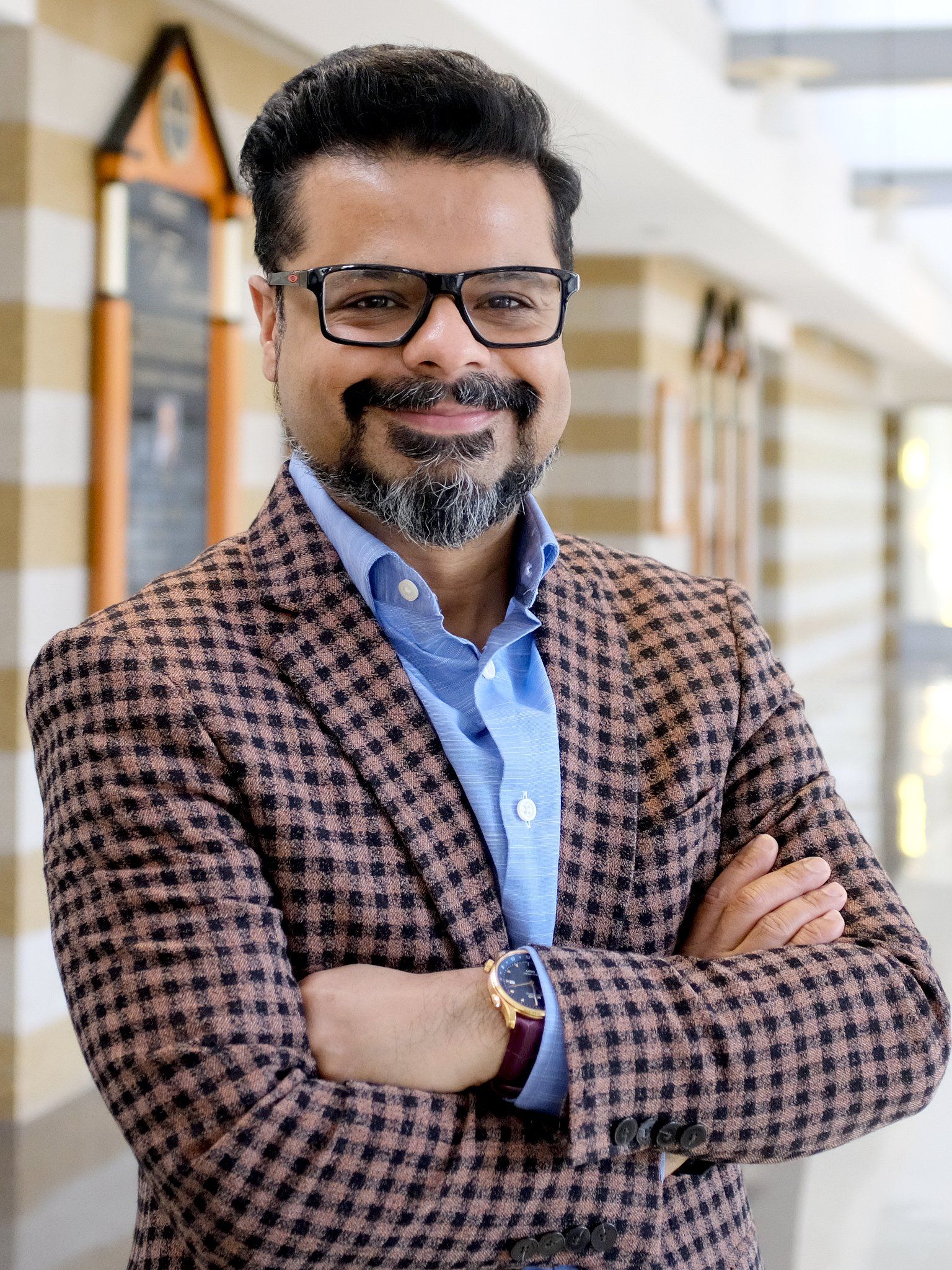
Part 1 – Author Interview with Professor Avi Datta
Q1 Professor Datta, your books transcend genres and have elements of Science Fiction, Romance, and Time Travel. Who would you describe as your ideal reader?
Thank you for the question. The answer is somewhat hidden in the book transcending genres. If you take the whole idea of The Core (explained in The Movement), the non-linearity of time, the aspects of the story are universal. Love, loss, orphanhood, not fitting in, sacrifice, misunderstanding, and death affect us all. So, my books can be enjoyed by those who are not into science fiction. To be honest, I am not sure if genres exist.
An ideal reader would not perceive emotion and logic as mutually exclusive entities but rather as equally important in making decisions. An analogy would be how the balance spring and the hairspring oscillate to mark the time division. In my book, some of the best decisions by Vincent (the protagonist) were made when emotions and logic were in sync. An ideal reader would also be cognizant of the rest of the world and the cultural nuances outside the USA or even the western hemisphere. While, The Winding touches on some nuances associated with racism, The Movement shows some severe problems with monoethnicity in Japan. But these are all woven into the story to make the context more relevant.
Q2 You have a unique background: a Professor of Strategy and Entrepreneurship at Illinois State University and an accomplished scholar in Technology Strategy and Strategic Entrepreneurship. Why the move into writing books? What role do you think your unique background and skills play in the writing of your books?
I wouldn’t characterize myself as an accomplished scholar. There are moments when I am disenchanted by the reality I am living in. So I decided to create another world. It’s not perfect, but it has far more interesting characters. I am still actively pursuing my research and academia.
I extensively studied great technologies that fail and terrible ones that succeed. In my doctoral dissertation, I looked at three million citation patterns across 200,000 patents in the IT Sector. I also looked at some of the most foundational inventions in the world. If IBM had not invented the magnetic card reader, we might not have Silicon Valley. Before creating the inventor—Vincent Abajian—I had to decide what could be a foundational innovation for the future. I read Nature AI, scoured through the UPSTO website, and concluded that transferring consciousness between humans and machines would be one such invention. To invent that, what other inventions do we need? There are no 50,000 pressure-point digital pens or a hologram you can pull out of a screen wearing sensory gloves. But to create the character Vincent, I had to conjure those up. There are plausible inventions. I have an imaginative mind, which helps in my academia and this as well. When I wrote The Winding in 2020, Rolex did not have a 41 mm Oyster Perpetual. But they launched one in 2021, making it perfect for the setting in 2023. BMW did not have a seven-series EV when I wrote The Winding. Now they do, which makes it authentic to the setting of The Winding in 2023 and 2024. My education has forged a way to imagine products for the future.
Q3 Your books challenge the core assumption that causality and time are linear. What exactly does it mean? What happens when a reader reads your book and questions the general assumption that causality and time are linear. Is this not opening up Pandora’s Box? Is the everyday reader equipped to handle this scary new reality that time and causality are not linear?
We measure time by the earth’s rotation around its axis and its revolution around the sun. As a child, I was fascinated by wheels and any circular motion and got depressed to see that their progress was measured linearly. This was also true for time. All the beautiful hand-finished details inside the movement for just measuring time linearly? (I still struggle with time when represented in digits.) Then I read a paper that stated past and future are just perceptions. It made logical sense because the Universe itself would not care how time is measured on earth. So I began to ask whether my instrument of Universe-time existed on earth. And what if someone can tinker with the synchronicity of earth and Universe time. Is this gift a curse? But that will only give us context, not a story. The story is about how specific universal themes, like love, loss, and greed, would evolve in such a context.
If one is too scared to open pandora’s box, then none of the great things we enjoy will come to fruition. At times, I think I should have just written one book. I have meddled too much in the lives of Vincent, Akane, and Emika. They are more real to me than most people around me.
Q4 With recent advances in AI, such as OpenAI’s ChatGPT, Google sharing some of its AI projects, and various AI Art programs becoming popular, many people are worried about what impact AI will have on humanity. What are your thoughts on AI’s recent rapid progress?
AI’s rapid progress will only pose a threat if humans don’t make progress. I don’t fear singularity, where a robot is indistinguishable from a human. I fear the opposite, where human thoughts and creativity look rudimentary and mechanistic.
AI’s rapid progress is something I am very optimistic about. AI can be used to better predict the weather, which will benefit farmers. If cars drive themselves, we would not need parking lots. My car will drop me off and come home. Humans are a product of six million years of evolution. So, machines won’t just take over. Yes, some jobs will erode. But that does not mean automation will lead to the extinction of humanity. If taxed creatively, excess profits from automation may lead to a Universal Basic Income, which should be higher than the wages earned from displaced jobs.
Q4B Professor Datta, do you think AI can replace human writers?
Magnus Carlsen is still the Grandmaster, right? At the most rudimentary level, AI recognizes and analyses patterns from predetermined inputs and applies context. With time, it learns more and refines. Something humans do. Many creative works—books, music, and literature have become formulaic. We take a structure and forcefully inject a story. This is also true for academic writing in journals. Some papers are so structurally similar that finding the uniqueness in context has become a rather dull challenge.
Instead of blaming AI for displacing writers, why don’t the creative content makers be more creative? I think the competition from AI will make authors leave their familiarity traps and compel them to make something more exciting. Who knows, we may see AI and humans teaming up to create exciting stories in the future.
Q5 What books and movies are similar to your books? Which authors are most similar to you as an Author?
From the non-linear standpoint, I would say movies like Inception and Mr. Nobody are similar. Story-wise, the manga Shingeki no kyojin (very different context) has non-linear causality. If you look at some of the universal themes in my book, you can find them in the works of Makoto Shinkai. I often cut a scene in my book and get to it when it becomes relevant. I found Satoshi Kon, a Japanese film director, to do the same.
Q6 Was there a particular book, experience, or moment that inspired you to become a writer? If so, please share.
In 1994, I dreamed of speaking with a girl fluently in Japanese. Trains were flying over buildings, and I was bidding goodbye to her. I ignored it and dived into Calculus, Statistics, and Quantum Mechanics. The dream reappeared again in 2020, and I could see the sunset in her eyes this time. So I named her Akane and started fleshing out the story. I wrote the story so that I wouldn’t forget it.
Q7 Your first book has racked up a lot of rewards in a short period, including the best Science Fiction Romance Novel from the Global Book Awards in 2022 and Top 5 Science Fiction Time Travel Books from Reader’s Favorite. As a first-time author, how/why did your book do so well? How could you bypass the common traps first-time authors fall for (the wrong editor, a lack of polish, not focusing on one series, not knowing how to market, not being able to capture their thoughts concisely and elegantly, etc.)?
Luck might play an important role. I wanted to write something different, and not being trained as an author, I did not know what I could not write. I did have a terrible editorial experience. This was during a very challenging time as well. The world was slowly reeling from COVID, and none of the literary agents I contacted wrote back. I was also not willing to go on their social media and write a book they wanted to read. I was not aware of resources available to indie authors as well. So I went to a platform and shortlisted three editors for structural edits. One agreed, one said that the book was too immature, and the third one never responded. The one who agreed took four months and had suggestions that showed they had never read the book. According to the editor, Akane was Vincent’s daughter. Even if I wrote a greek tragedy, that would not be possible. I looked into the editor’s Microsoft Word metadata. The total time spent writing the review sheet was 37 minutes. I did not lodge a complaint because that would mean wasting time and money.
Another thing I learned was impressions don’t sell books. And impressions can be bought. I think indie publishing or self-publishing is an excellent disruptor to the non-competitive world of traditional publishing houses that more or less bank on celebrities writing their memoirs. But, with the rise of self-publishing, we also see an increase in sneaky services that promise a lot and deliver nothing. New authors often get tempted to actively seek out bloggers. Which, in my opinion, is a waste of time as well. Editorial reviews are essential because google often indexes them at the top. I spend most of my time such that it is spent on the story itself.
My distributor, Bublish, has been quite good with matching editors I work with. I take editorial comments very seriously because they are the first outside my friends circle or me to have read my book with no bias. Distancing oneself from work is perhaps the best advice I learned from my professors. I still don’t know how markets work. And I have a Ph.D. in Business.
Regarding capturing thoughts elegantly, I have a condition—synesthesia (the production of a sense impression relating to one sense or part of the body by stimulation of another sense or part of the body).I saw the best cherry blossoms when I shut my eyes and listened to Chopin’s Andante Spianato e Grande Polonaise Brilliante Op.22.
Q8 What can we expect from you next? Will you be expanding the Time Corrector series after The Reset, or will it be a 3 book series? Would you be starting a new book series? Will you be branching into other genres?
I would like to see The Time Corrector getting translated into other languages. The story has global apparel, and we must understand that some people don’t read and write in English. The series would make an excellent series on television, animated or live action. But I don’t know who offers such services.
I am already conceptualizing a new story (genre-bending as well). I am still debating whether it will extend the Time Corrector Universe, especially after The Reset. While I don’t want to further stir the lives of Akane and Emika, I find it increasingly difficult to bid goodbye. It is not easy for me to imagine Akane mainly as just a figment of my imagination. I talk to her every day, in Jap-lish.
Q9 Professor Datta, do you think humans will be able to time travel at some point? If so, in how many years do you envision this happening? How do you think humans and humanity will be affected when this happens?
I hope so. Living in a world where time is linear is so profoundly dull. I have not studied physics to the extent of answering this question. But during my first semester as a Ph.D. student at Washington State, my roommate was a Ph.D. student in Physics. He said that even if it were possible, people emerging from such a device might be very different from what they were when they entered it. Assuming we get past that and devise a way to make it work, what then? Can I selectively change an aspect of my life, assuming everything else will be constant? If humanity decides to travel back in time, and undo certain things, then I am sure they will do something equal or more catastrophic.
The aspect of living in a world designed by the flawed choices we make is ruthless but also feeds into imagination and creativity.
Q10 Given your background (Professor of Strategy, Innovation, and Entrepreneurship), is it surprising you jumped into writing Fiction instead of a Business Strategy book? What was the reason for this? Will you write a book on Business Strategy or Entrepreneurship in the future?
I wanted to write something that’s not a tranquilizer for the insomniac. But isn’t there strategy and entrepreneurship in the series? Let’s examine. Having access to scarce resources is key to strategy. Politics surrounding access to intreton and control of intreton is extraordinarily strategic. What about the ability to tinker with time itself? Isn’t it a capability worth having? How far will you push to get such a capability in your grasp? In book two (The Movement), we will see some challenges to running a startup, especially when angel investors have a different view than Vincent. Of course, the treatment is more dramatic here. As the firm grows, we will see a shift from a startup mindset to a more managed entity mindset.
If I do write a book on entrepreneurship, I will make it stand out from the crowd. I have something in mind that might get translated into more than one language.
Q11 You are a very skilled and avid painter. How do your experience and expertise in art affect your writing? Did the experience of writing your books impact your art style or how you viewed your art?
Thank you. I have been painting since I was three. Painting keeps me imaginative. Some reviewers have commented that my writing is very pictorial, screen-ready, or like watching a movie. I picture every scene, the character’s clothes, and how the light reflects. Art, for me, has a more significant impact on my writing than reading.
I chose writing to express my imagination because I didn’t know how to show a beautifully flawed character beaten by realities through my brush. And yes, my writing has impacted how I perceive art. In the summer of 2022, I spent three months in Japan as a visiting scholar in innovation. That gave me insights into their rich culture and helped me flesh out Akane’s character. My future paintings will draw a lot of inspiration from woodblock paintings. Also, my concept of beauty has undergone a gradual transformation through my writing.
Q11B Which do you think is tougher – getting visibility as an author or a painter?
Both. But I have much less desire to share my paintings than my writings.
Q12 You are a big Coffee aficionado and have your own ‘Coffee Lab.’ What Coffee making secrets would you like to share with readers?
My coffee lab has become insufficient to experiment with my theoretical knowledge of pulling espresso shots. I need a flat burr grinder and an E-61 head with flow control. But few inexpensive habits can drastically change how one’s coffee tastes.
- If a coffee does not have a roast date (not a best-by date), don’t buy it.
- Weigh your beans. For pour, a good ratio is 1/15. For every 1 gram of coffee, you get 15 grams of water.
- The darker the roast, the lower the brew temperature.
- Well-brewed good coffee is not supposed to be bitter.
- A great espresso machine cannot neutralize a bad grind. Grinder > Espresso machine.
Q13 Professor Datta, on the website, you give hints about your characters drawing parts of themselves from you. Are they a mix of you and other people you have known, or are they primarily fictional with a few elements of yourself mixed in?
Interesting questions. According to one of my former graduate assistants. “Basically, Vincent is, you on steroids, right?” Then she tapped on her chin, asking, “So who is Akane?”
My answer: “The investigation is ongoing.”
I have met several characters in academia. And I have found that academicians with lower accomplishments prefer to add the title ‘Dr’ before their name. I have added that to my book. The rude TSA at the end of Book 1 is one I met in Atlanta. I would say most of the characters are primarily fictional, with characters of people I know sprinkled over them. Hulk is entirely based on my dog, Bruce the magnificent.
The most fictional is Akane and Emika’s characters. I may have poured all my love into creating them as Hajime Isayama may have done for Mikasa (Attack on Titan). I hope the book reaches Akane’s hand one day.
Q14 After reading your books, what other authors and books would you recommend for readers who can’t wait until 2024 for your third book? To satisfy readers’ new-found curiosity about the lack of linearity of time and causality
I would recommend A Brief History of Time by Stephen Hawkins, the whole Attack on Titan manga, and the movie Paprika.
*****
Thank you very much for reading this Author Interview
The Books Butterfly & Review Saint Team would also like to thank Professor Datta for his well thought out answers
Part 2 – Avi Datta Book Links & Website Links
You can get in touch with Professor Datta through his website and Twitter and LinkedIn –
Author Website – https://avi-datta.com/
Author Book Page at Amazon – https://www.amazon.com/stores/Avi-Datta/author/B09MWMCGFZ
Author Twitter – https://twitter.com/avimanyu_datta
Author Linked In – https://www.linkedin.com/in/avimanyu/
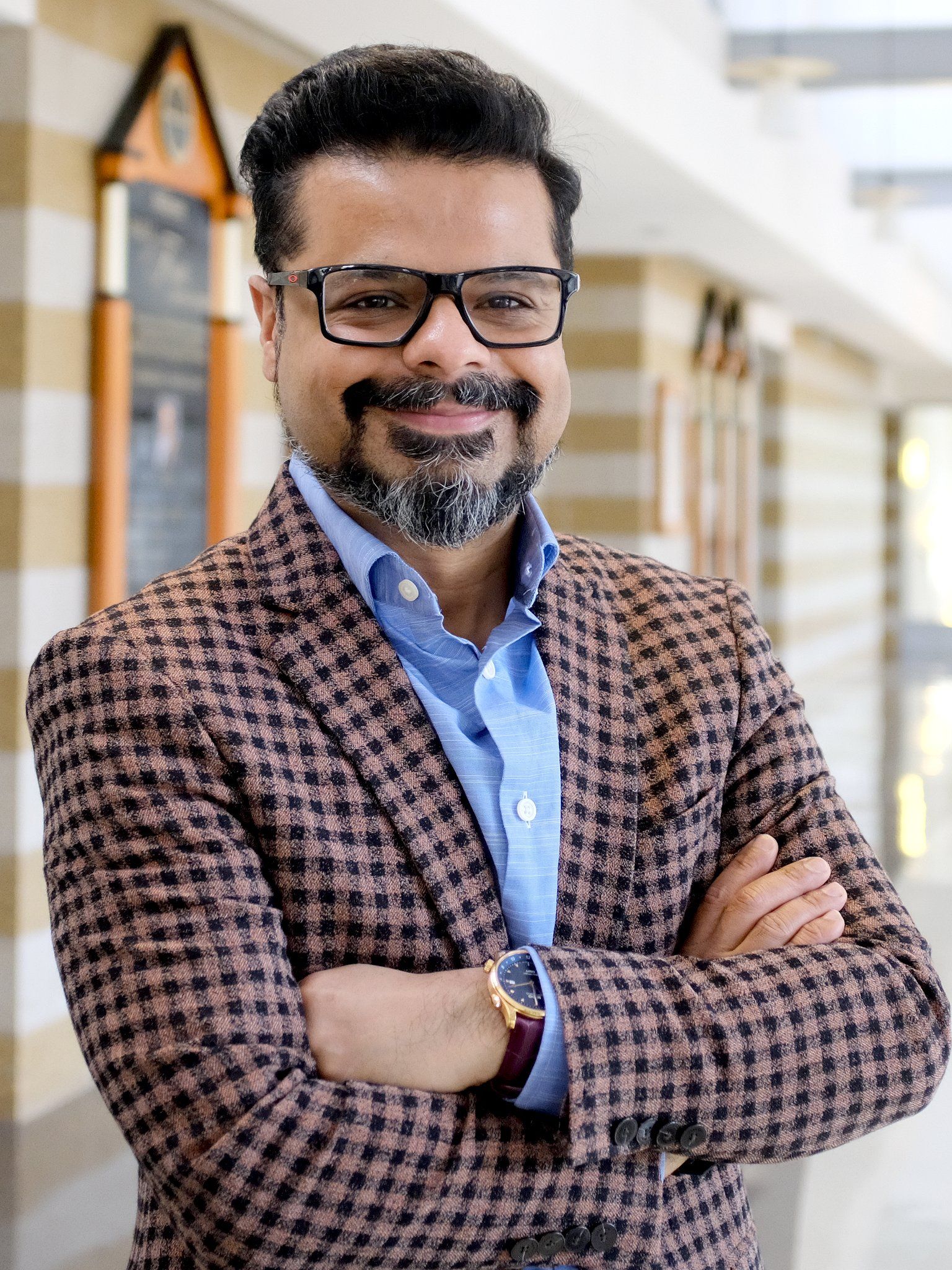
Author photograph (for Press Releases) – Avi Datta Author Photograph (please click on it to open it in Full Size)
Author’s Books at Amazon –
The Winding: https://www.amazon.com/dp/B09MR1VWJ7
The Movement: https://www.amazon.com/dp/B0BNJNPP25
Part 3 – Excerpts from The Winding and The Movement
3A -> Excerpt from The Winding Chapter 1
I can barely keep my eyes open with the makeup lights glaring at my face. Sophie, the show’s stylist, struggles to make my face presentable, using all kinds of pigments. She sees a little sweat on my forehead and quickly rubs it. The chair is squeaky, with no lumbar support, and I shift uncomfortably. I’ve placed my briefcase and scarf on the chair next to me. The wall opposite the mirror has eight posters of Maurice Johnson, the host.
“Nervous, Dr. Abajian?” Sophie asks around the makeup brush in her mouth.
“A little.”
“I didn’t think you would be.” She takes the brush off her mouth. “I saw how you rebuked the senators in the hearing. That was totally awesome.” Her eyes glow.
I shut my eyes and recall every incident that led me to the Senate floor in April this year.
“They had it coming.”
“Dr. Abajian? Did you mean it when you said that politicians can be replaced with algorithms?” she asks, squinting at me.
I smile. “Yes. And it doesn’t have to be a complicated one either.”
She fans the brush across my face. “It will be just a sec.” As she leans closer, the top note of her perfume is revealed—jasmine. Then she leans away again to look at her art, smiling. “You have nice wavy hair.”
“Thank you, Sophie.”
She puts her brush back and contemplates for a second. “Can I ask you a favor?”
“Sure.”
After reaching into her bag, she hands me a paperback of The Time Fixer: Three Lives of Philip Nardin. I scribble, “Dear Sophie, The future has already happened. But you can change it, Vince—August 15, 2024.”
Grabbing the book with both hands, she jumps up and down. “Thanks so much. Can I take a selfie with you?”
“Absolutely, but you should know I am not on social media.”
She tilts her head. “I know that.” Then she gets uncomfortably close to me, pouts her lips, and snaps a selfie. “Jim will come and get you soon. It was totally awesome to meet you.”
I blink. “Likewise, Sophie.”
She leaves, waving at me as she goes out the door.
Alone again, my mind starts racing, and my chest begins to pound. What questions will Maurice ask? About my book? About my performance in the Senate that put three senators in jail? Those are easy ones. What if he asks about my personal life?
I snap my fingers. Sparks transform into a miniature core—a white luminant sphere levitating an inch over my palm. As I examine the sphere, I think about what it means. I am the key to the time turbulence, a secret I discovered only a few days back. Inside the time turbulence, I can change the past and the future. Closing my palm, I dissolve the core. Mr. Kruger never revealed what I could do with the sparks, and only recently had I understood why—I had to find out myself.
I straighten my necktie and adjust my pocket square. The necktie button has gotten looser. I’ve lost fifteen pounds, five of which were since August 13, when I did the unthinkable. Yes, given the task’s magnitude, I’d had my doubts—my incompetence with the sparks to create turbulence. And, even if I could muster the power, should I? Emika would forget me. But, as my resolve strengthened, I could create turbulence through these sparks. There was no stopping me. Emika is now free, and I am OK with her not remembering me. Maybe that’s why she never returned my voicemail that I left on August 13. But that dream this morning… Is she coming back?
I lift my cuff to look at my watch. It’s 4:25 p.m. My JLC Reverso is now ticking beautifully at 21,600 vibrations per hour, 6 ticks per second. But it stops when I enter my property, just like all my mechanical watches. It means only one thing—my action on the thirteenth removed my property from this reality.
Which dial goes better with my blue shirt and charcoal plaid suit? Is the white dial with local time or the black dial with GMT—Emika’s time? Let’s toss a coin. I throw a penny into the air, and there’s a knock on the door. As soon as the door opens, I can hear the crowd chanting “Maurice, Maurice” against the poorly orchestrated sound of the trumpet, drums, and bass guitar. Jim comes forward. “We are ready for you.” The coin lands on my left palm. Showtime.
3b – Excerpt from The Movement
Not knowing the nature of this trick, I blurt out with a shaky voice, “Are you lost?”
My jaw drops as she turns around. Her smile is radiant, from her beaming lips to her glinting eyes flickering in restrained tears. She locks her gaze with mine, then brings her hands to her mouth and breathes deeply.
What trick is this? I look at my JLC Reverso. It’s ticking—six ticks per second. So, we are not removed from reality. As I look back at her face, my tears gush as if they were waiting for this moment.
I know your face; it stands out among millions in Shibuya. It’s deeply etched in my memory. I have sketched your face, imagining how you might look growing up. And boy, was I right. I don’t cry before humans, but you are everything.
Her face gets all blurry as tears block my eyes.
But I can’t rub my eyes; what if, at that moment, you disappear again?
I want to hold this image forever. I don’t want to wake up if this is a dream. How did this happen? Is it linked to my first trip to the core, which I faintly remember? I don’t care how or why. My nature to seek logic is diminished because of the miracle before my eyes.
Blinking back her tears, she comes closer and grabs the lapel of my robe. Smiling, she tilts her head and says, “Not anymore.”
Flurries begin to drop—gently savoring every last second of the air before reaching the earth and disappearing. She drops her trench coat on the bluestone patio. I see her wristwatch—a platinum Philippe Dufour. Her skin glows against her short-sleeved, cobalt-blue, bell-bottomed jumpsuit. The belt, tied like a bow on the right side of her waist, is made from the same cloth. She shimmers, brighter than her platinum bracelet lined with an array of two-carat diamonds. She takes off her jade chopsticks, and her silky hair falls to her waist. Stepping back into the open, she twirls around and lets the flurries touch her slender arms. Each flurry sparkles and glints as they get close to her skin. Light shimmers more brightly around her.
She turns to me and smiles, squeezing her eyes into two lines of thick eyelashes. Opening her eyes wide, she says, “I told you I’d be back before the flurries, right?”
I fall to my knees. I shut my eyes as every moment without her reflects back at me. My voice trembles as I respond, “You left out the thirty-three years part.” When I look up at her, she touches my head. “I told you not to go,” I rasp. “How could you just leave me like that? I kept waiting and waiting. How could you be so cruel, Akane? Are you gonna disappear again?”
This is the first time the flurries are touching my skin since she left me. I forgot what they looked like, what they felt like. I open my palm to see the flurries drop, float on my tears, and dissolve.
Part 4 – Additional Thoughts on The Winding and The Movement
These books are very unique – Books that not only will entertain you, they will also expand your view of reality and will nourish your mind
The author is a Professor of Strategy, Innovation, and Entrepreneurship at Illinois State University and also a talented Artist. He combines academic rigor with creativity and the books are splendid. As one reviewer put it -> This is one of those books that you are proud to leave on your bookshelf for years to come.
It’s very unusual for a new author to win awards with their first book. The fact that The Winding has won multiple awards within its first year of launch is perhaps one of the best indicators that these are high quality books and well worth your time


Leave a Reply